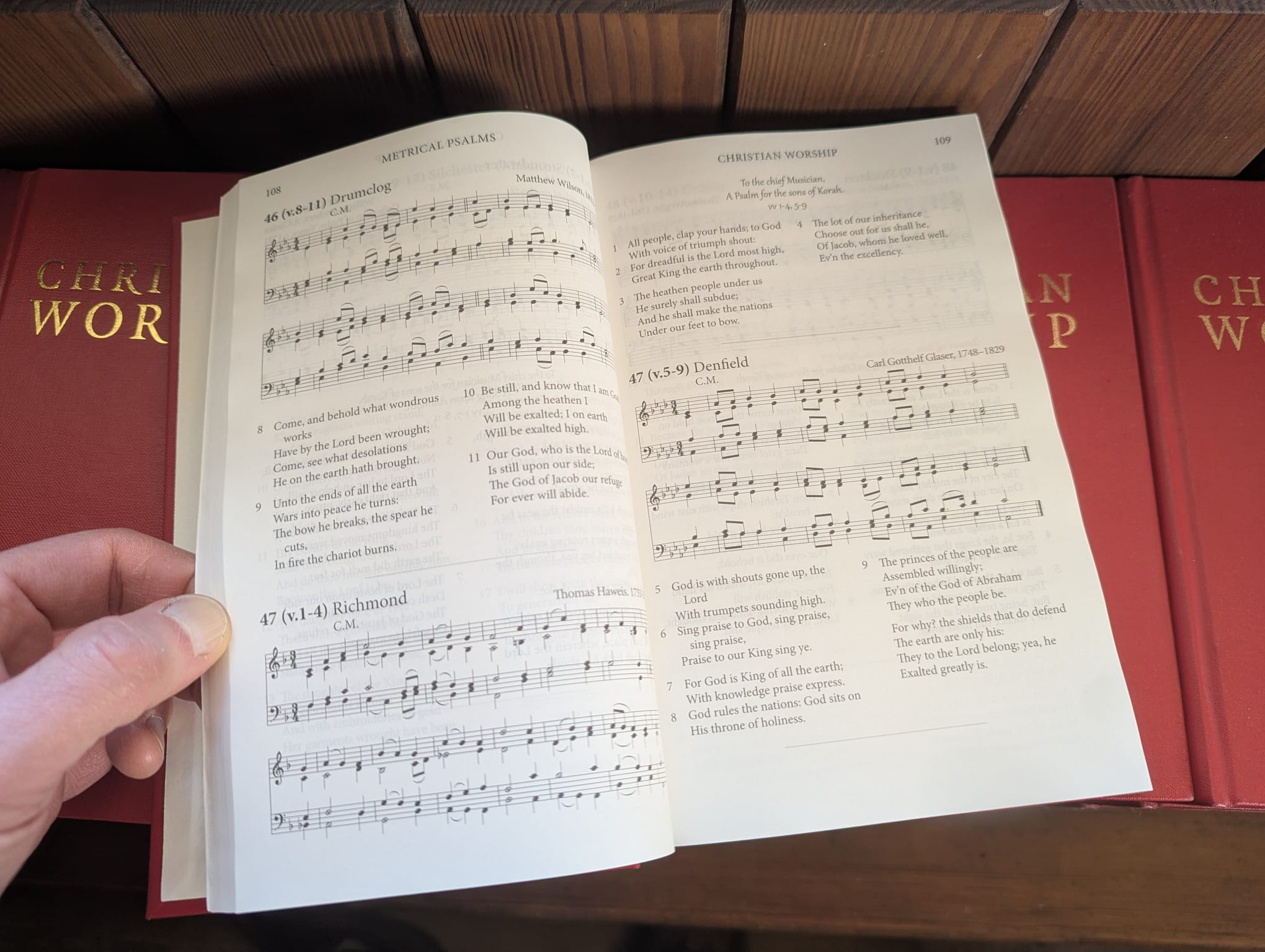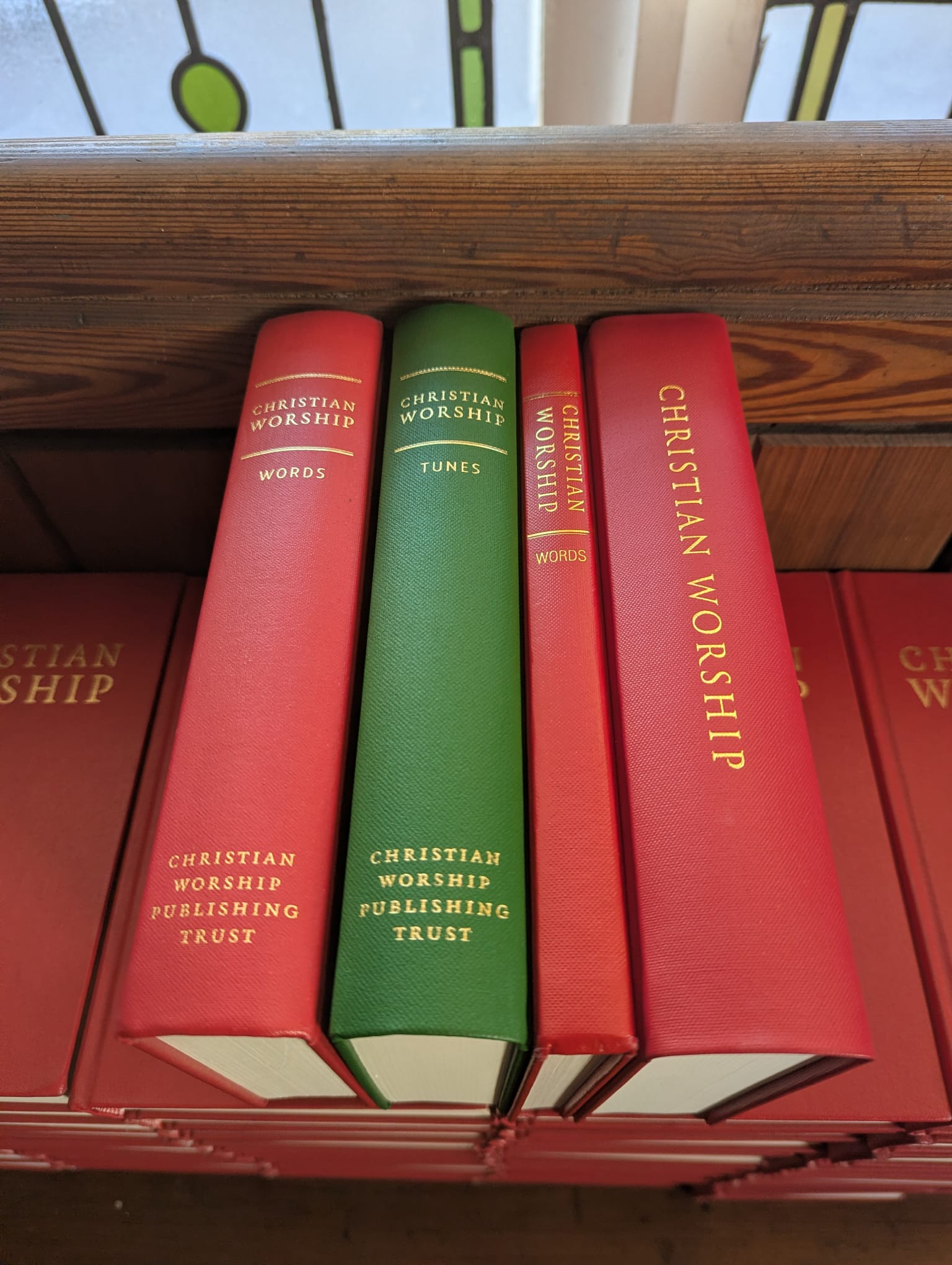
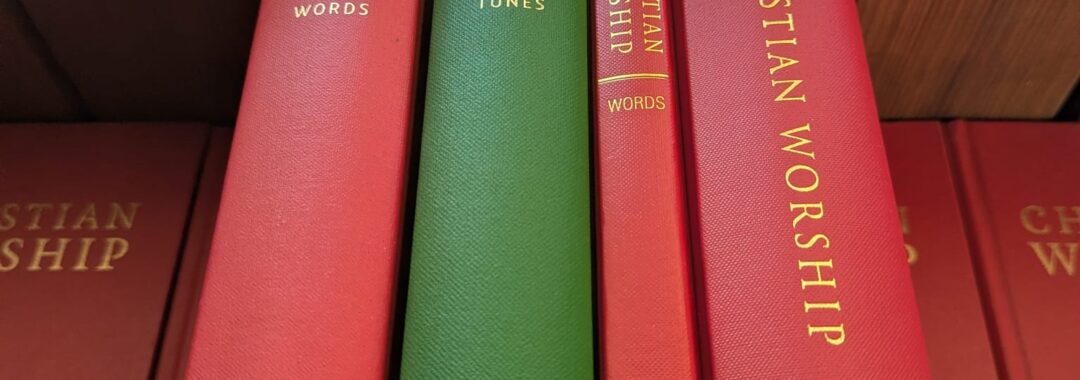
We are pleased to announce that the newly published Combined Words and Music hymnbook is now available for purchase through this website. Please select the ‘Buy Hymnbook’ button at the top of any page for information on price. The picture below shows the relative sizes of the books. With over a 1000 tunes, the Combined book was always going to be big, in spite of using thinner paper than the previous Tunes edition.
Below you can read the publisher’s introduction to the Combined book…
Christian Worship was first published in 2009, in pursuit of the Trustees’ vision co uphold traditional values of reverent praise in the worship of Almighty God. The original format comprised separate books of words and tunes. We made recommendations, but left the ultimate choice of tunes to the taste of individual churches and their accompanists. Encouraged by a number of users, we have for some time nurtured the hope of creating a single volume combining both words and tunes. The difficulties of this are obvious. The words book comprises the complete metrical psalter, plus 1041 hymns, while the separate tune book contains 1086 tunes. The sheer volume of this material is daunting, and such a large book may present a practical problem for organists.
The resulting volume, printed on lightweight paper, is therefore something of a compromise. The entire text of the psalms and hymns is retained in full, but with a significant reduction in the number of lesser-known tunes. Nevertheless, the original tune book continues to be available, offering the full range of tunes, including those necessarily omitted from this volume.
The longer psalms are separated into several sections, conforming to the traditional divisions, and each section has its own allotted tune. As the great majority of the psalms are common metre, there is wide scope for using alternative tunes if desired.
Each hymn also has its own specific set tune, and in many cases an alternative is also suggested. Clearly, a combined volume reduces the “mix-and-match” flexibility of a separate tune book. If this is a disadvantage, it is offset by reducing the need for ministers and accompanists to choose tunes individually. A large proportion of the set tunes perpetuate well-established hymn-tune associations. Nevertheless, we have not spurned the inclusion many less familiar tunes.
The question of familiarity, and preference for well-known tunes is largely a personal matter, depending heavily on one’s own church background. The Baptist, Free Evangelical, Methodist or Presbyterian may have different views of what is unquestionably the “right” tune for any given hymn, and dismiss all the others as “wrong”! The same may apply to national preferences. In many cases we have restored hymns from a particular ecclesiastical source to the tunes with which they were previously associated in their native background. However, we have not followed this principle slavishly.
We would re-iterate the closing sentiments expressed in the introduction to the original tune book. While there are many well-known tunes, there are also a few that have not, as far as we know, appeared in any previous English language hymnal. Some have their origin in folk songs, though we have tried to avoid those which may have inappropriate connotations. Some tunes have been rescued from undeserved oblivion, and it is our hope that they will find favour with a new generation of worshippers.
No doubt the book will be used in a variety of ways, depending on the musical capabilities and preferences of each local church and its accompanists. We hope that the use of tunes that are already well-known will help to continue lively and intelligent worship. We also trust that the judicious introduction of other noble, though less familiar, tunes will bring a new freshness, helping to consolidate praise in the traditional style as the fitting accompaniment of Spirit-anointed preaching, and supremely worthy of the God whom we serve.